> For the complete documentation index, see [llms.txt](https://help.quickappflow.com/llms.txt). Markdown versions of documentation pages are available by appending `.md` to page URLs; this page is available as [Markdown](https://help.quickappflow.com/user-management.md).
# User Management
User management is the process of controlling user access and permissions in a system, including tasks like authentication, authorization, and account management.
Go to **User Management** App.

Go to User Management tab.

## Role Definition
Permissions are often assigned based on user roles. Different roles may have different levels of access to particular app. For example, an administrator might have full control permissions, while a standard user might have limited access.
Click on **+Role Definition.**

Click on **+Role.**

Enter **Role Name**, Select **Application and Permission,** Click on **Save.**

A new **Role** is added at the top.

## Team
User can create team.
Click on **Teams** to create team.

Enter **Team Name** and **Users** which you want to add in the team (Here shows only those users which are mapped in user mapping) and click on **Save**.

A New **Team** is added at the top.

## Give Permission to User or Team
You can give access of any app to individual or team.
Click on **+Permission.**

Select Individual user or team and assign role which you want and click on **Save**.

A New permission record is added at the top.

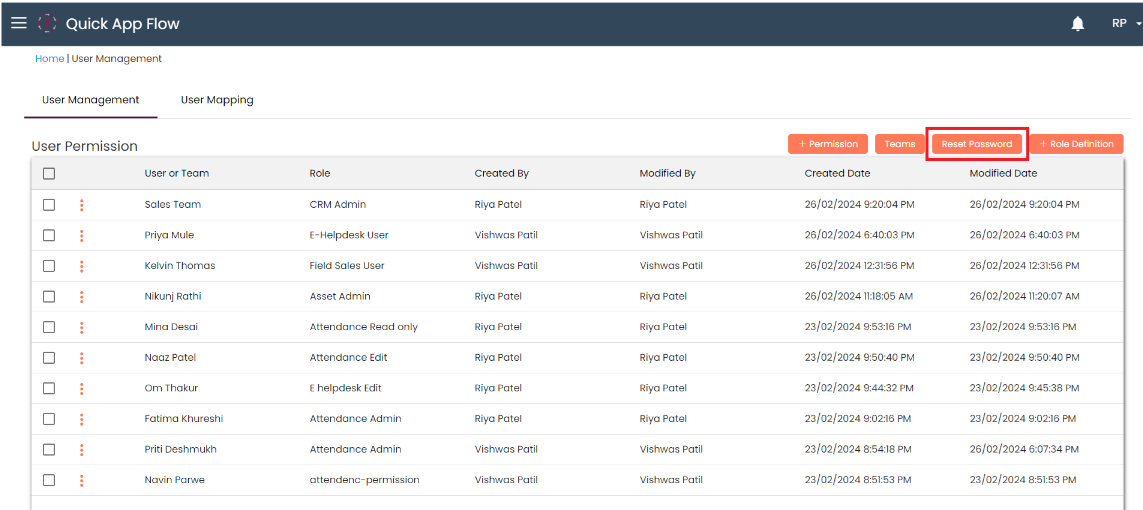
## Reset Password
Resetting a password is the process of changing an existing password to a new one, usually because the user has forgotten it or for security reasons.
Click on **Reset Password.**
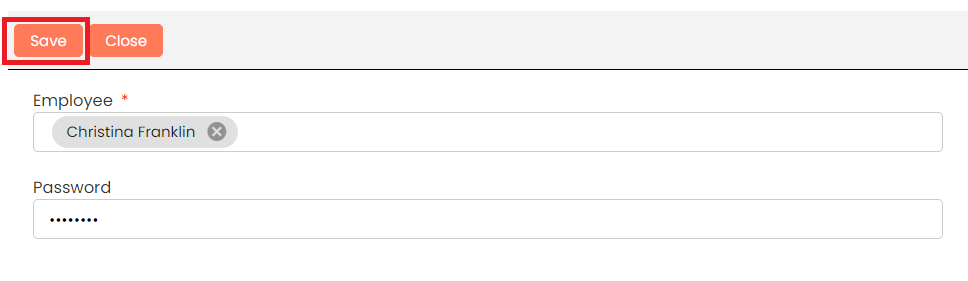
Select the **employee** for whom you want to reset the password, enter the **new password**, and **save** the form.
## User Mapping
User mapping is the process of linking user identities with resources or permissions in a system, ensuring appropriate access and security.
Go to **User Mapping** tab and click on **+New Record** tab.

Select App name as **CRM** and select users which you want to allow for CRM and click on **Save** button.

## Edit User Mapping
You can choose to edit the user mapping that you have created.
To edit user mapping.
Click on the Action (3 vertical dots)  for the record which you would like to edit and click the **Edit** button.

Make the necessary changes and click **Save.**

## Delete User Mapping
User mapping once added can be deleted if no longer necessary.
To delete user mapping.
Click on the Action (3 vertical dots)  for the record which you would like to delete and click the **Delete** button.

Give your confirmation in the pop up and the record will be deleted.